 Let's talk
Potato storage ventilation
Potato warehouse ventilation systems direct airflow through the tubers. SiloPapa uses forced ventilation by suction and recirculation to support post-harvest potato preservation, with four speeds and CO₂ extraction.
How it works
The right airflow,
at the right time.
The system reads temperature, relative humidity, and CO₂ to monitor storage conditions. Suction ventilation and recirculation direct air through the stored product.
Ventilate
Outside air enters uniformly through the vents.
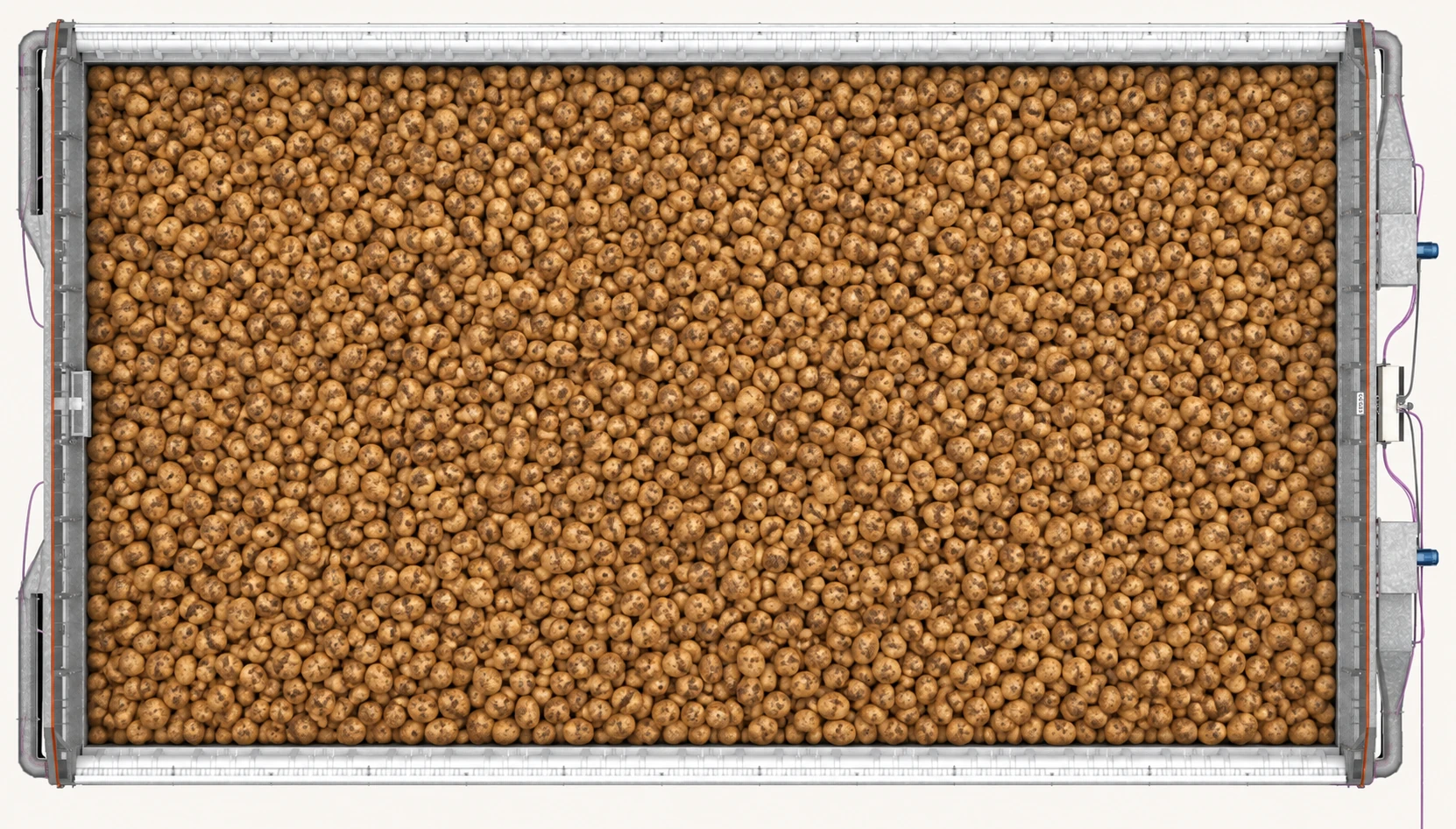
Light blue · inletRed · outlet
Uniform inlet → through the potatoes → air and CO₂ extraction
When outside conditions are favorable, the fans draw air evenly through the potatoes to renew the atmosphere, cool the load, and remove accumulated CO₂.
Recirculate
The silo's own air circulates through the load again.
Light blue · continuous circuit
Through the potatoes → side return → internal air circuit
Internal air returns along the sides and flows through the potatoes again. This movement helps stabilize temperatures and evenly distribute oxygen using the silo's own air.
Illustrative airflow diagram. Bubbles make circulation visible; their colors and speed do not represent measured temperatures or airflow rates.
- Automatic or manual operation
- Temperature, humidity, and CO₂ readings
- Curing and storage modes
Adjustable capacity. The values of 53,400 m³/h and 110 m³/t/h represent maximum ventilation capacity. Variable-frequency drives provide four selectable speeds to adapt airflow to storage needs at any given time. Explore potato ventilation →
A simple process for the entire season
Install
Assembly at the selected site, without building a fixed storage facility.
Load
500 tonnes per module, in bulk.
Program
Set the target and operating mode.
Monitor
Temperature, humidity, and CO₂ from your phone.